
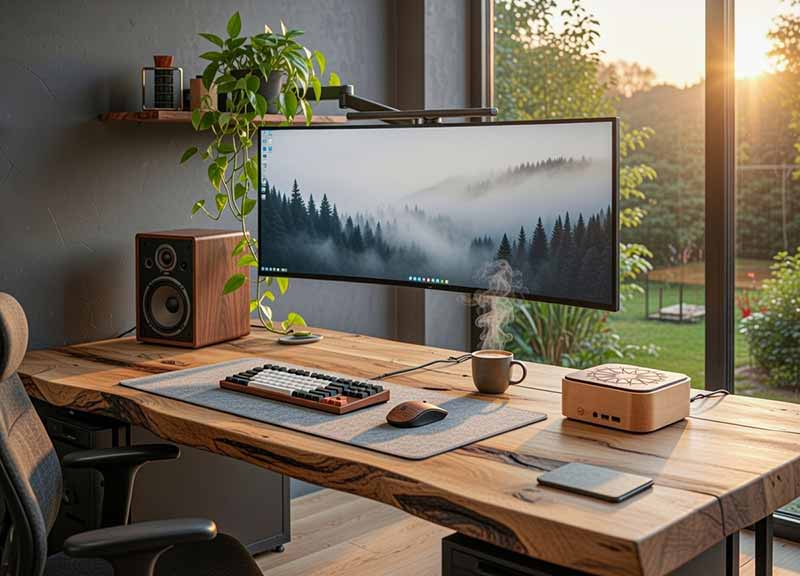
It is the great paradox of this decade. On one hand, we want our homes to be smarter than ever. We want voice assistants, lighting controlled at our fingertips, media servers streaming 4K to every room, and connected security. On the other hand, we crave a visual disconnect. We are tired of black screens, blinking LEDs in the middle of the night, and the “clinical” white plastic that defined the smart home aesthetic of the 2010s.
In 2026, the trend is no longer about technological ostentation. The “Smart Home” must become invisible. It must blend into the decor. This is the advent of Organic Tech: ultra-high-performance objects on the inside, dressed in natural materials on the outside.
How can we reconcile cutting-edge home automation with a return to nature? Here is an analysis of a transition where wood is reclaiming its rights over silicon.
I. Audio Led the Way: A Lesson from Audiophiles
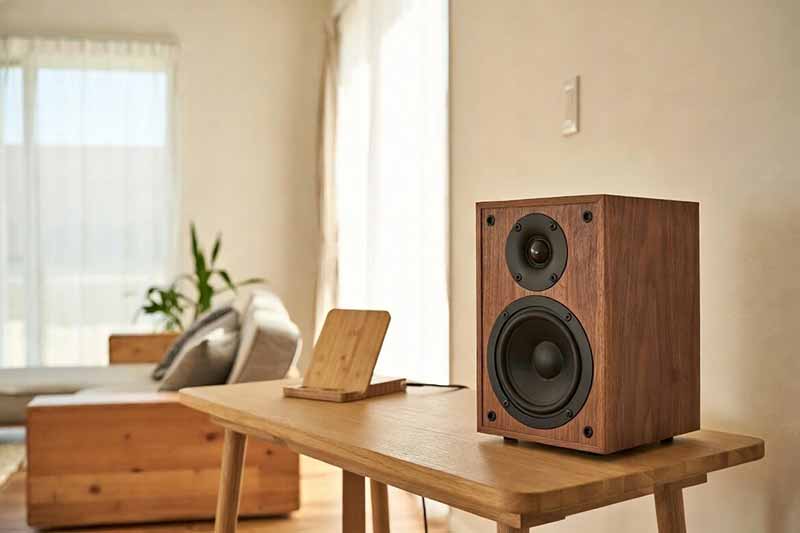
While the computing world is only just discovering the virtues of wood, the world of High-Fidelity (Hi-Fi) has known it for a century. A plastic speaker sounds “hollow.” Wood, through its density and rigidity, offers a warm and precise resonance.
Today, this acoustic requirement meets an aesthetic one. Soundbars and connected speakers are no longer hidden; they are becoming centerpiece furniture.
Look at legendary brands like Klipsch or Edifier. They integrate Bluetooth 5.0, Wi-Fi, and voice assistants into walnut or cherry wood cabinets that recall the 1970s. It is the perfect marriage: your speaker answers to “Alexa” or “Siri,” but visually, it remains timeless.
Editor’s Choice: If you are looking to marry sound and design, the Edifier S1000MKII active speakers or the Klipsch Heritage range are perfect examples of this trend. They prove that wood isn’t “retro”—it is acoustically superior.
II. “Calm Tech”: Concealing Ambient Intelligence
“Calm Tech” is the idea that technology should only demand our attention when necessary. The rest of the time, it should simply be part of the environment. Silicon Valley designers have finally understood this:
- Connected Frames: No more black screens on the wall. Products like the Netgear Meural use matte displays and real wood frames (walnut, birch) to display artwork. On or off, it looks like a painting, not a TV.
- Invisible Charging: Phone chargers are often the ugliest objects in a house. The answer? Bamboo or solid wood charging stations that organize cable chaos. Even better: bedside lamps with induction charging integrated into a wooden base. The technical function disappears behind the decorative one.
IIII. The Heart of the Home: The Mini PC as a Home Server
In a connected home, you need a brain—a “Hub.” Often, it’s an old laptop lying around or a noisy tower hidden in an overheating cupboard.
This is where SixWood redefines the standard. If you use a computer as a home automation server (to run Home Assistant, for example), as a media center (Plex, Kodi), or simply as a family PC in the living room, it should not be a visual eyesore.
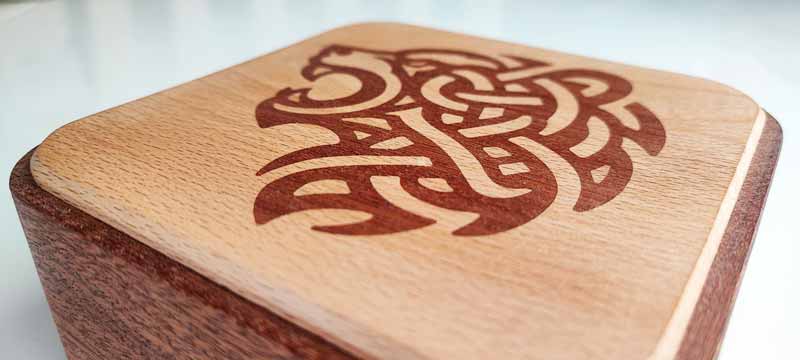
The Art of Modern Marquetry: Beyond Stickers In our previous article on customization, we mentioned the importance of the unique object. For our “Connected Home” models, we go even further technically. Unlike laser engraving, which “burns” the wood to draw a pattern (a common technique that leaves a black mark), SixWood practices solid inlay.
- CNC Cutting: A high-precision digital milling machine carves the wood of the cover (Beech, for instance) to a depth of 6 to 8 millimeters.
- “Wood on Wood” Assembly: We then cut the pattern (the negative) from another wood species (Sipo for contrast).
- The Fusion: The two pieces are assembled, glued under pressure, and then sanded until perfectly smooth.
To the touch, there are no ridges. You have a complex, monoblock piece of cabinetry. It is the difference between a tattoo and a graft. This level of finish is usually found in luthiery or luxury car dashboards—not in computing.
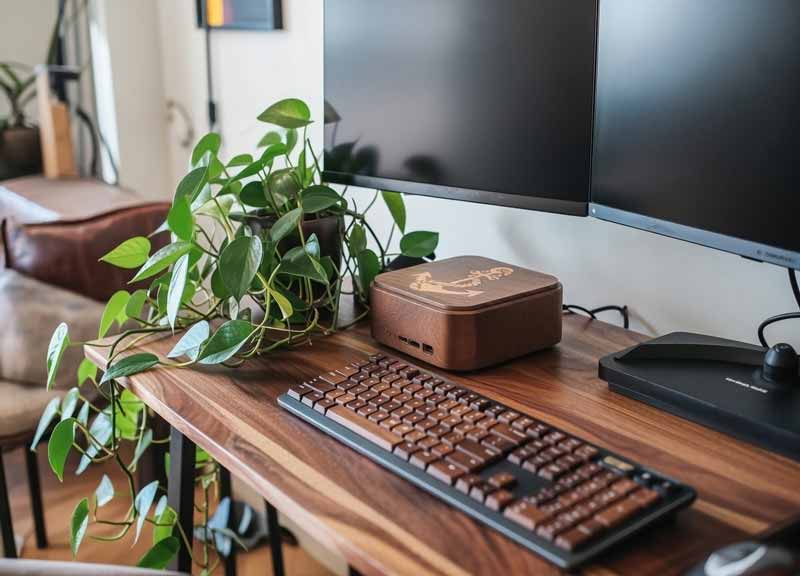
This Mini PC can sit proudly in your living room next to your amp and plants: no one will guess it is the one controlling your entire home.
IV. Weather Stations & Climate: A Return to Noble Materials
Another sector of the smart home has undergone a transformation: climate management. While pioneers like Netatmo used anodized aluminum, the trend is going further. We are seeing weather stations and air quality sensors dressed in wood.
Why? Because these objects speak to us of nature (temperature, humidity, CO2). It is semantically logical for them to be made of a natural material. A shiny plastic humidity sensor is an aesthetic nonsense. A wooden sensor breathes coherence.
Editor’s Choice: To dress up your sensors or voice assistants (such as Google Nest or Amazon Echo), wooden stands and mounts are now available to break away from the “clinical white plastic” look of the original devices.
V. The Keyboard and Mouse: The Final Tactile Mile
Finally, if your home is connected, you likely have a control interface somewhere—a tablet, or a keyboard/mouse set on the coffee table to control the TV or PC.
Here again, cold plastic is no longer inevitable. Touching wood is soothing (scientifically proven to lower heart rate). Accessories like solid walnut wrist rests or mechanical keyboards with wooden chassis transform digital interaction into a sensory experience.
Conclusion: Technology is Not the Enemy of Nature
The mistake would be to oppose the “Smart Home” (futuristic, cold) against “Nature” (old-fashioned, rustic). The two can and must coexist.
The future of the connected home is not in the overabundance of visible gadgets, but in integration. Technology is there to serve us, not to invade our visual space. By choosing objects like wood-finish Hi-Fi speakers or SixWood inlaid computers, you are affirming that you live in a home, not a laboratory.
You are taking back control. Your interior remains a soothing cocoon, while hiding a formidable technological power beneath its wooden cloak.